Swap Nodes in Pairs
LeetCode 24 | Difficulty: Medium
MediumProblem Description
Given a linked list, swap every two adjacent nodes and return its head. You must solve the problem without modifying the values in the list's nodes (i.e., only nodes themselves may be changed.)
Example 1:
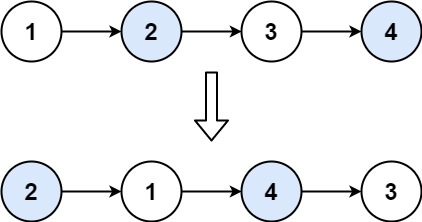
Input: head = [1,2,3,4]
Output: [2,1,4,3]
Explanation:
Example 2:
Input: head = []
Output: []
Example 3:
Input: head = [1]
Output: [1]
Example 4:
Input: head = [1,2,3]
Output: [2,1,3]
Constraints:
-
The number of nodes in the list is in the range
[0, 100]. -
0 <= Node.val <= 100
Topics: Linked List, Recursion
Approach
Linked List
Use pointer manipulation. Common techniques: dummy head node to simplify edge cases, fast/slow pointers for cycle detection and middle finding, prev/curr/next pattern for reversal.
In-place list manipulation, cycle detection, merging lists, finding the k-th node.
Solutions
Solution 1: C# (Best: 92 ms)
| Metric | Value |
|---|---|
| Runtime | 92 ms |
| Memory | 23.1 MB |
| Date | 2019-12-15 |
/**
 * Definition for singly-linked list.
 * public class ListNode {
 *     public int val;
 *     public ListNode next;
 *     public ListNode(int x) { val = x; }
 * }
 */
public class Solution {
    public ListNode SwapPairs(ListNode head) {
        if(head==null || head.next == null)
        {
            return head;
        }
        head.next.next = SwapPairs(head.next.next);
        ListNode first = head;
        ListNode second = head.next;
        first.next = second.next;
        second.next = first;
        return second;
    }
}
📜 3 more C# submission(s)
Submission (2022-02-16) — 132 ms, 36.9 MB
/**
 * Definition for singly-linked list.
 * public class ListNode {
 *     public int val;
 *     public ListNode next;
 *     public ListNode(int x) { val = x; }
 * }
 */
public class Solution {
    public ListNode SwapPairs(ListNode head) {
        if(head==null || head.next == null)
        {
            return head;
        }
        head.next.next = SwapPairs(head.next.next);
        ListNode first = head;
        ListNode second = head.next;
        first.next = second.next;
        second.next = first;
        return second;
    }
}
Submission (2017-08-07) — 156 ms, N/A
/**
 * Definition for singly-linked list.
 * public class ListNode {
 *     public int val;
 *     public ListNode next;
 *     public ListNode(int x) { val = x; }
 * }
 */
public class Solution {
    public ListNode SwapPairs(ListNode head) {
        if (head == null || head.next == null)
	{
		return head;
	}
	ListNode n = head.next;
	head.next = SwapPairs(head.next.next);
	n.next = head;
	return n;
    }
}
Submission (2017-08-07) — 173 ms, N/A
/**
 * Definition for singly-linked list.
 * public class ListNode {
 *     public int val;
 *     public ListNode next;
 *     public ListNode(int x) { val = x; }
 * }
 */
public class Solution {
    public ListNode SwapPairs(ListNode head) {

    //iterative
    ListNode dummy = new ListNode(0);
	dummy.next = head;
	ListNode current = dummy;
	while (current.next != null && current.next.next != null)
	{
		ListNode first = current.next;
		ListNode second = current.next.next;
		first.next = second.next;
		current.next = second;
		current.next.next = first;
		current = current.next.next;
	}
	return dummy.next;
}
}
Complexity Analysis
| Approach | Time | Space |
|---|---|---|
| Linked List |
Interview Tips
- Discuss the brute force approach first, then optimize. Explain your thought process.
- Draw the pointer changes before coding. A dummy head node simplifies edge cases.